Air Brakes Practice Test
Take the timed practice quiz →
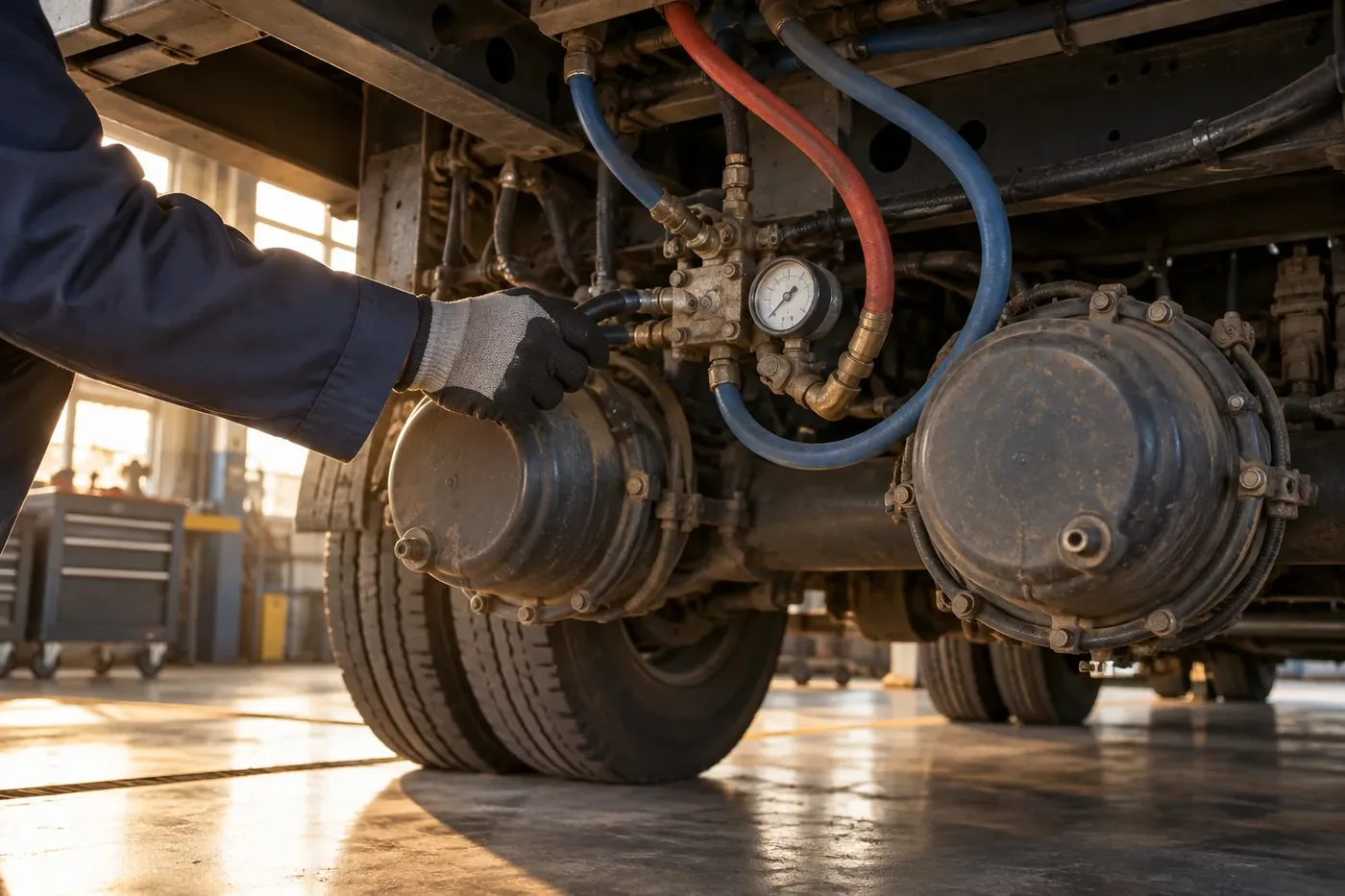
The Air Brakes test is required for any driver who will operate a commercial vehicle equipped with full or partial air brake systems. Topics include the air compressor and governor, supply and service tanks, brake chambers and slack adjusters, S-cam and disc foundation brakes, parking and emergency (spring) brakes, dual air systems, anti-lock braking, leakage tests, and the proper sequence for daily inspection. Failing or skipping this test will cause an air brake restriction to be added to your CDL.
How to use this practice bank
Read each question carefully before checking the answer. Most CDL questions are not designed to trick you, but they do test whether you know the specific rule — not just what feels safe. After reading the explanation, try to restate the rule in your own words; if you can, you've internalized it. If you can't, look up the corresponding chapter of your state's CDL handbook before moving on.
Pass scores vary slightly by state, but most jurisdictions require at least 80% correct on each knowledge exam. With 55 questions in this bank you have substantially more practice material than any single sitting of the real exam, which typically contains 20 to 50 questions per endorsement.
All 55 questions in this bank
- #1The braking power of the spring brakes:
- #2The most common type of foundation brake found on heavy vehicles is the:
- #3The supply pressure gauges show the pressure:
- #4The application pressure gauge shows the driver:
- #5The air compressor governor controls:
- #6If your truck or bus has dual parking control valves, you can use pressure from a separate tank to:
- #7All vehicles with air brakes must have a low-air-pressure warning signal that activates:
- #8The brake pedal in an air brake system:
- #9The trailer hand valve should:
- #10Modulating control valves let drivers:
- #11You should drain the air tanks:
- #12A straight truck or bus with air brakes built after 1975 must have an emergency brake system that uses:
- #13The proper procedure for checking the slack adjusters with the engine off and the parking brakes released is to:
- #14Why drain water from compressed air tanks?
- #15The air loss rate for a straight truck with the engine off and brakes released should not be more than:
- #16For a combination vehicle, the maximum allowable leakage rate with the engine off and the brakes released is:
- #17When you make an emergency stop with air brakes you should:
- #18Total stopping distance for an air-braked vehicle is the sum of:
- #19At 55 mph on dry pavement with good brakes, an empty truck-tractor will need about how much total stopping distance?
- #20Spring brakes will come on automatically when air pressure drops to within the range of:
- #21Brake fade is caused by:
- #22The proper way to use service brakes on a long downgrade is to:
- #23The best way to control the speed of a vehicle on a long downgrade is to:
- #24Before driving a vehicle with a dual air system, allow time for the air compressor to build up at least:
- #25What is the most important thing to remember about brake adjustment?
- #26You should know your vehicle's air brakes are working properly because the law requires you to:
- #27A dual air brake system has two separate air brake systems that:
- #28When parked, you should:
- #29When the air storage tank pressure rises to the cut-out level (around 125 psi), the air compressor:
- #30If you must drive a vehicle with air brakes that have a slow air leak, you should:
- #31The air brake system is fully charged when:
- #32Why is it best to apply the air brake parking brake when finished driving for the day?
- #33Front-wheel brakes on a truck:
- #34The most common cause of serious skids in heavy vehicles is:
- #35What is the air brake system's emergency function?
- #36You should test the trailer service brakes by:
- #37A trailer's emergency brakes are activated by:
- #38What two systems make up a dual air brake system?
- #39You will know if there is a problem with the dual air system if:
- #40Why is it important to know how the dual air brake system works?
- #41You can use a brake-pedal application test to check air loss because:
- #42The braking power of an air brake system depends on:
- #43The brake-system warning light tells you:
- #44Improperly adjusted brakes will:
- #45Why do air brakes get wet inside?
- #46Air brakes use compressed air to:
- #47When stopping in normal conditions with air brakes, you should:
- #48What is the proper following distance in good conditions if you are driving a 40-foot truck at 55 mph?
- #49You should know that the air compressor is doing its job by:
- #50A vehicle equipped with anti-lock braking systems (ABS) will:
- #51When the ABS warning light stays on after start-up:
- #52When making an emergency stop on a vehicle with ABS, you should:
- #53What is one main advantage of having ABS on a tractor-trailer?
- #54Compared with hydraulic brakes, air brakes:
- #55At what minimum pressure should the spring brakes apply on a typical tractor?
About the Air Brakes exam
The Air Brakes knowledge test is a multiple-choice exam administered at every state CDL testing site. The questions on this page are seeded from the AAMVA Commercial Driver License Manual — the same source that state agencies use when writing their official questions — and from the corresponding sections of Title 49 of the Code of Federal Regulations. Real test questions are randomly selected from a much larger pool, so practice covers the rules and concepts rather than the wording of any one item.
The most efficient way to study is to work through this bank twice. The first pass identifies the rules you do not yet know; the second pass confirms recall. Drivers who have studied for years rarely miss a question, but newcomers should expect to need a week or more of repeated reading and quizzing before sitting the real exam. Combine this site with your state's printed CDL handbook for the most complete preparation.
Recommended study materials
Genuinely useful books for this exam, available on Amazon.